
Based upon my book, The Spirit of Health: Mind-to-Toe Self-Care for Women
From the segment: Tools for Self-Discovery & Life Enhancement
“Some trees grow very tall and straight and large in the forest close to each other,
But some must stand by themselves or they won’t grow at all.”
Oliver Wendell Holmes
On the path of self-discovery it’s natural to focus with a “micro-view” on the obvious things that make up the various aspects of yourself. Yet when your eyes are open only to your immediate surroundings, it’s easy to lose sight of the overall picture, the sum of your parts, the “macro-view.” When I saw my own path beginning to take a new turn, I felt an urge to straighten my course. I was tired of stumbling along. I wanted to remove the obstacles, or to at least identify them so that I could go around them. With a deeper understanding of my life as a whole, I knew I could make better decisions and widen my path. Intuitively, I knew I needed to do some serious reflection about my life.
I began doodling on a piece of paper, and what emerged became what I called the Me Tree, a “life line” of the events and experiences that made me what I am and who I am today. Through this exercise a deep and accurate reflection of my true self emerged. To learn about ourselves, we often delve into the history of our “family tree.” The focus of this tree is not self-discovery, but ancestral discovery, a way to see where we fit into the familial scheme of things. With a family tree, we can easily see our “roots,” and the “limb” from which we grew. But with a Me Tree, what unfolds is your own individual life, your personal tree of self-knowledge.
The Me Tree is a powerful tool for self-discovery because instead of focusing on everyone else, you focus only on you.
I turned a legal pad upside down and drew a horizontal line near the bottom of the page. Below the line I drew roots to represent my family. Above the line I wrote my name and date of birth. From the middle of this line I drew one vertical line straight up and through the center of the entire page, which became the main stem of the tree.
Then I drew short horizontal lines out from the “stem” to represent anyone and anything; the people and events that stood out as I looked back, that held a place in my heart, mind and soul. It’s important to do this in a “free form” sense, not looking for any particular patterns or connections; you just go with it.
It’s like fishing in a pool of memories for anything that bites. And remember to keep the little ones; nothing on your life line is too small or insignificant if you remembered it. If it means something to you, then write it in. The ones that seem small might get a lot bigger when you see how they form the pattern of your past. Sometimes it’s the smallest things that have the biggest impact, so don’t judge what comes to you. And don’t analyze it—yet. The patterns will emerge by themselves. Save the analysis for later when you’ve got enough “fish” in your life bucket.
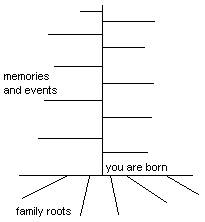
My first entry was my best friend Blenda; our parents had been friends, too. If friends were gems, Blenda would be my diamond. Only a year old when I was born, she always said that she taught me how to walk. I always said I was glad she didn’t limp! My next entry was Taffy, my first dog, who bounded into my life when I was about five. Next came the Catholic grade school I attended, and the words, “math and talking.” To me, this was the memory of a math teacher who struck me whenever I struggled with math, and another teacher who put masking tape across the mouths of children who spoke up too much, including myself. My memories became my entries—summers on grandpa’s farm market; dad always telling me to be quiet; winters at a family cabin up north; mom’s “problems.” I recorded, “2 OFBE’s,” which meant two out of body experiences that I recalled from early grade school.
The entries unfolded as I searched out my memories; there were things there I hadn’t thought about for years. I wrote the names of other friends as they came into my life—the gems, the semi-precious and the artificial. The words, “Taffy died,” brought back tearful memories of a great dog. I moved on up the life line into high school; a class trip to Germany; surgery on my “tail” bone—which I contend was my “inner wolf” trying to get out; my first yoga class in 1976; then graduation; a fall-out with my father; and an involvement with an older man who hurt me so badly that I could only write the first initial of his name for fear of resurrecting his energy on the page. Moving; college; marriage; divorce; moving; marriage; the birth of my daughter; moving; relationships that required “emotional shin guards”; and on it progressed as the chronicle of my life unfolded.
“From every scrap you make a blanket.”
Rose Chernin, writer
Encompassing over 40 years, my tree included many of the joys and the pains that we as women collectively share—the joys of marriage, and sometimes the pain of divorce, the changing seasons and our changing selves—the innocence of the Maiden, the love of the Mother, the wisdom of the Crone—our passages. Together our hearts bend and nearly break as we lose grandparents, parents, friends and even children. We recognize the times of beauteous bounty, and the times of soul-starvation, the times when we thought we were heading for a breakdown, and the other times, where we knew we’d had a breakthrough.
I noticed that the word “move” came up way too many times in the tree of my life, yet I certainly had become an expert packer! They say we learn from struggling—with my Me Tree, I realized how much I had learned. With a Me Tree, the entries unfold as you climb the ladder of the years, and life becomes more clear.
For me, this exercise was an epiphany because I was able to see how my past had been influencing my present. Like a light in a fog, it became quite clear to me that as a child I had been hushed, always told to shut my mouth; that I had too much to say. In grade school I was admonished for speaking my mind and asking too many questions. For that I was silenced.
That silence seemed to set the stage for me to not listen to myself, for denying my own inner voice.
With the “macro-view” I saw that as an adult, I had followed this pattern and chose to become a court reporter, a career that kept me “quiet.” For years I sat silently in a courtroom, mouth closed. Toward the end of my career, I even used a reporting method called the “Stenomask,” one where the reporter whispers into a mouthpiece that neatly and completely covers the mouth area—just like the masking tape of my grade school years. My opinions, comments and creativity had been squelched, and inside I suffered. The Me Tree showed me that I had also involved myself in relationships where I felt that what I had to say wasn’t valued or important. It was like a part of me was missing.
I realized that if you’re told to keep quiet most of your life, you tend not to trust your own voice. This was one roadblock I needed to identify.
“That is what learning is.
You suddenly understand something you’ve understood all your life,
but in a new way.”
Doris Lessing, English writer
The Me Tree pointed out many glaring life patterns that I had been unable to see before. With newfound clarity I was able to shift gears personally and professionally. As my inner voice began to manifest, I began to write, and I haven’t stopped since! Once I heard my own true voice, I began to realize what I needed and what I wanted, and what I would not tolerate or accept anymore. I felt my own finger on the pulse of my essential nature, what I loved and what my true talents were. After a couple of years of getting to know my true self, a healthy partnership manifested “out of the blue,” different from the relationships of my past, with a man who is eager to know what I’m thinking and who values what I have to say.
Your Me Tree can be done in one sitting or you can work on it bit by bit, for as long as you desire. It can extend through one page, or through many.
The more that goes on in your life and the longer you live, the taller your tree will grow. The Me Tree is a way of stepping outside yourself and looking at life with a more objective perspective. This tool can help you to identify connections, patterns, motivations, and habits that ironically repeat themselves. You can see various life events that left an indelible imprint upon your psyche, upon your spirit.
Perhaps you’ve been driving down the same old road, over and over again, hitting the same potholes along the way. With an objective view, you can develop a more acute awareness of the connections between the things that happened and the events that followed. You can see why—why you accepted this relationship, or chose that career, why the state of affairs in your life are what they are—and then you can maneuver around these potholes and roadblocks. A macro-view arms you with choices to help shape your future, rather than have it be shaped by unconscious echoes from the happenings of yesteryear.
“My favorite time of year is right now.”
Dell Gerard
We are the essence of our life experience but we are not our past. We each have a history, but we don’t have to repeat it. Your past does not have to equal your present or your future. You can leave your past behind. What happened is what happened. What you’ve done is what you’ve done. Through the vast experiences of your past you develop more compassion and insight, and often more peace in your life. With self-knowledge we can look our histories in the face and learn from them, toss out what didn’t work, and improve upon what did.
Memories are like compost, and they get all mulched up and mixed in with our present. But just like decay can nourish the soil, memories can nourish the soul. I’ve always felt that things happen for a reason, and that we are exactly where we’re supposed to be, right now, at this very moment, but that we don’t have to remain there. It’s up to you to place yourself in different surroundings, to know that you do have a choice, and that you’ve got plenty of right now.
Through the revelations of the Me Tree, you can turn over a new leaf.
“Life can only be understood backwards,
but it must be lived forwards.”
Soren Aabye Kierkegaard, Danish philosopher and theologian